
Nebraska business name search is the check a founder runs before paying for a filing and the check a buyer runs before trusting a brand. The corporate search page reads the same index that holds every entity and every trade name on file, so a query shows what is already taken. A name that clears is not protected by that clearance, but a name that fails will not be accepted.
This page covers the search, the comparison the office applies, the reservation that holds a cleared word, the trade name that lets a business use a brand, the trademark question the state cannot answer, and the charges attached to each filing.
How to Search Nebraska Business Names
The search page takes a word or a phrase and returns every entry that carries it. Start with the term that gives the business its identity rather than with the full legal string, because the list is what exposes a near twin. A name check is worth running more than once: before the reservation, before the articles, and before the sign is ordered. Another filer can land between those dates.
Search the Distinctive Word
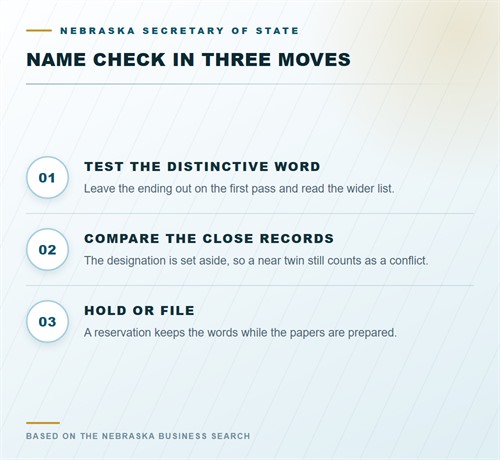
Begin with the identifying word and hold the designation back. A place name fills a page, while an invented term returns a short list. The type and city beside each result narrow it, and the wider index opens from Nebraska business name search on the front page. The list is more useful than a single hit, because it shows how the index treats similar wording. Note the number beside each close match so a second search does not repeat the work.
Check the Trade Name Index
A trade name is filed separately, and it can sit in the index without a formation document behind it. A company name that clears the entity list can still be in use as a brand by an existing business. A search on the storefront name returns nothing when the brand exists only in that index. A second search on the owner name often finds the registration and the entity behind it.
Nebraska new business information:
https://sos.nebraska.gov/business-services/new-business-information
What a Name Entry Shows
A name entry is a filing record rather than a marketing profile. It carries the legal name, the type, the entity number, the standing, and the dates attached to each paper. It does not show revenue or reputation. The entry answers two questions first: whether a name is taken and which entity holds it. Those two answers are what a founder or a buyer needs before any other detail.
Legal Name and Trade Name
The legal name is the one printed on the formation paper, and it holds the main line in the index. A trade name has its own registration and names the owner behind the brand. The Nebraska LLC records page shows how a company name appears on a formation record. A reader who searches a storefront should look in that index as well.
Former Names
A company that changes its legal name files an amendment, and the earlier string stays in the history. A query on the old name may return the current record with a note, or it may return a line that points to the new entry. The Nebraska corporation records page follows the same history for a charter.
The Rules That Decide a Name
A proposed name is accepted when it is distinguishable from the records already on file and it follows the requirement for its class. The office applies the comparison when it reviews the document, and a name that cleared last month can fail if another filing landed in between. The rules apply to every class, but the designation changes with the class. A founder who plans to convert later should pick a name that survives the change.
Distinguishability
Two names conflict when a reasonable person would treat them as the same business. The designation is set aside in the comparison, so a company and a corporation built on the same distinctive words can still collide.
Required Designation
A limited liability company must carry Limited Liability Company, L.L.C., or LLC. A corporation must carry a recognized ending such as Corporation or Incorporated. A nonprofit uses a corporate ending as well.
Restricted Terms
A name that suggests a bank, an insurer, or a government body can need a consent before the office accepts it. A professional practice adds a licensing condition, and the credential has to exist before the name can be used.
Name Reservation
A reservation holds a cleared name for a limited period while the formation papers are prepared. It is optional, and it is useful when a founder needs time for signatures or a lease. The reservation does not create an entity. A reservation is a placeholder rather than a decision, and it can sit unused while the plan changes. The applicant can transfer the reservation to another party with a short filing.
Filing the Request
The request names the proposed name, the class it is meant for, and the applicant. The office checks the index and issues a reservation when the name clears. The confirmation belongs with the formation papers.
Term and Transfer
A reservation runs for the term printed on the confirmation. A founder who lets it lapse may find the name taken. A transfer of a reservation carries its own charge.
Trade Names
A trade name lets an existing company or a sole proprietor use a brand without forming a second entity. The registration records the owner, the brand, and the term, and it appears in the index beside the legal names. The filing is a disclosure rather than a grant of rights. It does not reserve the brand against another business, and it does not create a company.
What the Registration Shows
The registration names the owner, the brand, and the address, and it prints a filing date. It does not show the ownership of the entity, and it does not show a trademark.
Renewal
A trade name runs for a term and expires unless it is renewed. A renewal carries its own charge, and the owner has to be current to file it. A lapsed registration leaves the brand unlinked in the index.
Names for a Nonprofit
A nonprofit uses a corporate ending and states a purpose in its articles, and the name is read with that purpose. A name that suggests a private benefit can raise a question at the state desk and again at the federal desk. A charity that plans to seek federal recognition should avoid a name tied to a commercial product. The determination letter is issued on the documents, and a name that reads like a brand can slow the review.
Trademark Checks Beyond the Office
The state index is not a trademark register. A name that clears the office can still infringe a federal mark or an unregistered brand that another business has used in trade. A federal search is free and takes less time than a rejected application. The result shows the mark, the class of goods or services, and the owner.
Unregistered Rights
A business that used a name without registering it can still hold rights in its area. Those rights are local and fact dependent, and a state search will not reveal them.
Name Fees
The search costs nothing, and the amounts below cover the filings that hold or register a name. Nebraska lists a lower amount for an online filing on the trade name application.
| Name item | In office | Online |
|---|---|---|
| Name search | $0 | $0 |
| Application for reserved name | $30 | $30 |
| Transfer of reserved name | $30 | $30 |
| Application for trade name | $110 | $100 |
| Amendment of trade name | $30 | $30 |
| Renewal of trade name | $110 | $110 |
| Assignment of trade name | $30 | $25 |
| Application for trademark | $110 | $110 |
| Certificate with a seal | $10 | $10 |
Frequently Asked Questions
Founders, brand owners, and buyers asked the questions below about a free name.
Is a Nebraska name search free?
Yes. The index opens without a profile and charges nothing for a query. A charge applies to a reservation, a trade name, or a formation. A founder can test several spellings before paying anything.
Does a reservation guarantee approval?
No. It confirms the index on the day of the request. The articles still have to pass review, and another filing can land in between. A reservation is a placeholder rather than an approval.
How long does a trade name last?
The registration runs for a set term and lapses without a renewal. A lapsed brand stays on a sign while the index no longer links it to the owner. A renewal is a short filing, and a calendar note at the term date prevents the lapse.
Can two businesses use the same word?
Sometimes. The index looks at confusion, and a different trade with a different customer can support the same word. A trademark search is the next check, because a federal mark can block a name the state accepts.
Do I need a trademark to use a name?
No. A name can be used in trade without a registration. A trademark adds a stronger claim in a separate system, with its own search and its own fee. A founder who plans to spend on signage should run that search early.