
Nebraska corporation search opens the record that the Secretary of State keeps for a business corporation, a nonprofit, or a professional company, and that record is the one a bank, a buyer, or an officer reads first. The corporate search page returns the name, the entity number, the type, the standing, the agent, and the papers on file.
This page covers the corporate side of the register: the classes the office files, the articles that create each one, the directors and shares the public record does or does not show, the biennial report, the route back from a lapse, and the charges that apply.
How to Search Nebraska Corporation Records
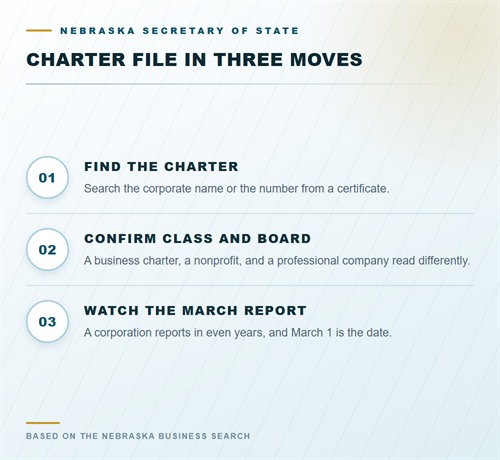
The search page offers one name field and one number field. A reader who has a certificate should use the number, because it opens the file directly. A reader who knows only the trading name should start with the name and narrow by type. Corporations sit in the same index as every other class, so a corporate query can return an LLC and a trade name that share the wording. The type column tells the business corporation from the nonprofit, and the wider index opens from Nebraska corporation search on the front page.
Search by Corporate Name
Enter the distinctive term and leave Corporation or Incorporated for a second try. A place name returns a mixed list, which helps when the class is still unknown. Where the first attempt returns nothing, try an earlier name. A corporation that amended its articles keeps the old string in the history, and a query on the agent name is the other practical route.
Search by Entity Number
The number is issued when the articles are accepted and it does not move when the name changes. It can be read from the charter, from a report notice, or from a sealed certificate. A typo in the number returns an empty page, and that page is easy to read as a company that never filed. Check the digits against the paper before drawing that conclusion.
Reading the Result Grid
A row shows the name, the identifier, the class, the town, and the condition. A long page usually means the query word was wide. Filter by condition and date, then open the entry that matches the address on your paper.
Nebraska corporate services:
https://sos.nebraska.gov/business-services/corporate-and-business
What a Corporate Record Shows
A corporate file is a set of charter papers rather than a business profile. It states what the corporation filed, when the office accepted each paper, and which addresses and agents were declared. It does not list customers, revenue, or litigation. The file answers three questions: whether the charter exists, who receives service, and what has been submitted. Every other question belongs to another office.
Class and Charter
Nebraska files business corporations, nonprofit corporations, and professional corporations, and each class has its own articles. A business charter authorizes shares, while a nonprofit charter states a purpose and issues none. The class decides the report form, the reinstatement amount, and the papers that can be filed later. A reader who skips the class field can misread a nonprofit as a business corporation. The Nebraska LLC records page covers the limited liability side.
Directors and Officers
The articles name the initial directors, and later filings can restate the board. The public record does not carry a full officer list, and it does not show a shareholder ledger. A contract signed by an officer should be checked against the company minutes.
Registered Agent and Office
The charter names a Nebraska street address for service and a party who accepts it. A post office box is refused in both fields. The principal office, where the company works, is a separate field. A paper delivered to the wrong one can leave the board unaware of a claim. A reader who checks a vendor should compare both fields with the address on the contract.
Forming a Corporation
The charter comes into being when the office accepts the articles, and the number is issued at that moment. The organizer enters the corporate name, the accepting party, the street address, and the first board. A business charter adds the authorized share count. A founder should clear the name before writing the articles, because a refusal costs a filing. The agent and the address come next, and the share decision comes last.
Articles of Incorporation, Business
The business form asks for the corporate name with an accepted ending, the agent and office, the principal address, the authorized shares, and the names of the initial directors. The incorporator signs, and the company exists from the filing date.
Articles of Incorporation, Nonprofit
The exempt form asks for a purpose clause, a dissolution clause, and a statement about members. It does not ask for shares, and the charge is lower than the business filing. The purpose and the dissolution wording carry into a later federal application.
Professional Corporations
A professional corporation adds a statement about the licensed service, and the shareholders must hold the credential. The name cannot suggest a service the company is not licensed to provide.
Directors, Shares, and the Corporate Book
The state file holds the charter, the amendments, and the reports. The bylaws, the minutes, and the stock ledger stay with the corporation, and a buyer who needs them has to ask during diligence. A small corporation often has one person in every role, and the record shows that person as incorporator and director. A larger one separates the board from management.
Authorized and Issued Shares
The articles state the shares the corporation may issue, not the shares it has issued. A reader who needs the issued count should ask the company for the ledger. An increase to the authorized count requires an amendment.
What the Public File Omits
The file does not name the shareholders, and it does not show the price paid for a share. It does not carry a buy-sell agreement or a voting trust. A reader who treats the charter as a cap table will overstate what the record proves.
The Biennial Report
A business charter reports in even numbered years, and March 1 is the date. The office marks the report delinquent after April 15. A long silence can close the charter. The form restates the accepting party, both addresses, and the mailing point. It asks for no balance sheet and names no owner.
Deadline and Filing
The filing period opens before March 1 and the online service takes the report inside it. An early submission clears the cycle, while a late one runs into the April delinquency mark.
What the Report Confirms
The form repeats the accepting party, the street address, and the mailing address. A company that moved or swapped its agent during the cycle should fix both fields on that form.
Losing Standing and Reinstatement
A corporation that skips its report can be marked delinquent, and a longer lapse lets the office dissolve the charter. A closure date then appears on the file, and enforcing the company agreements becomes harder. A closed charter may still show a return further down the list. A company that came back reads differently from one that never did.
Reinstatement
The application names the company and the reports that never arrived, and it carries a state charge. Once the paper clears, the office puts the charter back. The list then carries the closure and the return as two entries. The Nebraska business status page reads that condition.
Late Reinstatement
Nebraska also publishes a late reinstatement for a company that has been closed for a longer period, and that route carries a much larger charge. A filer should check which form fits before posting the document.
Amendments, Mergers, and Dissolution
A charter changes through an amendment or a restatement, and both leave the earlier paper in the list. A merger combines two companies and ends all but the survivor. A dissolution closes the charter. Each filing has a different effect on the file. An amendment keeps the company in place with new terms, a merger moves the assets to a successor, and a dissolution ends the registration.
Amendment and Restatement
The amendment names the article that changes and the new wording, and it posts with a date. A restatement replaces the whole document in one filing. Neither one moves the entity number.
Merger and Dissolution
A merger leaves a survivor whose file carries the combined charter, and the absorbed companies show an end date. Articles of dissolution close the charter, and a revocation of dissolution can undo that closure if it was filed in error.
Corporate Fees
No fee applies to the lookup. The corporate amounts below cover the filings a charter usually needs, with the online figure beside the counter figure.
| Corporate item | In office | Online |
|---|---|---|
| Articles of incorporation, business | $110 | $100 |
| Articles of incorporation, nonprofit | $30 | $25 |
| Articles of amendment | $30 | $25 |
| Articles of dissolution | $30 | $25 |
| Certificate of authority, foreign corporation | $110 | $100 |
| Certificate of authority, foreign nonprofit | $30 | $25 |
| Reinstatement of a charter | $30 | $30 |
| Late reinstatement of a charter | $500 | $500 |
| Certificate with a seal | $10 | $10 |
| Articles of merger | $30 | $30 |
Frequently Asked Questions
Officers, buyers, and attorneys sent these questions about a Nebraska charter.
Is the Nebraska corporation search free?
Yes. No profile is needed, and the state adds nothing to a lookup. A charge belongs to a filing or to a paper ordered from the office. The search page and the fee schedule are separate pages.
Does the record show the shareholders?
No. The charter shows the authorized shares rather than the issued ones, and the shareholder ledger stays with the company. A buyer who needs the issued count should ask for the ledger and a signed representation.
When is the corporate report due?
Every two years, in even numbered years, by March 1. The report is delinquent after April 15. A long lapse can close the charter, and a late reinstatement then carries a much larger charge.
Can a dissolved charter be restored?
Yes. A reinstatement restores the registration, and a late reinstatement exists for a longer lapse at a much larger charge. The file keeps the closure and the return as separate entries, so the gap stays visible.
Does a foreign corporation report in Nebraska?
A registered foreign corporation follows the Nebraska cycle and keeps a Nebraska agent while its authority lasts. The home charter remains the source of the company’s existence, and the local file answers only the authority.
Where does a certificate come from?
The office issues it on request for a small charge, and it states the standing on the day of issue rather than the history. A bank usually wants one dated within the past few months.