
Nebraska business status search answers the question a counterparty asks first: does this registration still hold? The corporate search page prints the current condition beside every result, and the record shows how that condition came about. A word such as active, delinquent, or dissolved changes the weight of every other field on the page.
This page reads the standing rather than the search box: what each value means, which events move a company from one value to another, why a buyer or a lender cares, how a closed file returns, and the papers that prove the condition to a third party.
How to Check a Nebraska Business Status
The condition appears near the top of an entity page, beside the type and the formation date. A reader can reach that page with a name or an entity number, and either route lands on the same blocks. The lookup is free and needs no profile. A reader who wants the wider index can begin at Nebraska business status search on the front page.
By Name
A name query returns rows with the condition beside each one, so a reader can screen several companies before opening a file. A shared word produces a long list, and the city is often what separates two firms that chose the same name. A company that renamed itself may still sit under the older string on a directory site while the state page shows the live entry. Where no match appears, try the registered agent.
By Entity Number
The number lands on one file and removes the ambiguity of a name. It appears on a certificate, a report notice, and an older receipt, and a rename never moves it. A wrong digit produces a blank result rather than a close match, and a blank result is easy to misread as a company that never filed. Compare the digits with the paper first, and the Nebraska LLC records page shows the fields behind the number.
Nebraska annual and biennial reporting:
https://sos.nebraska.gov/business-services/annualbiennial-reporting
What Each Standing Means
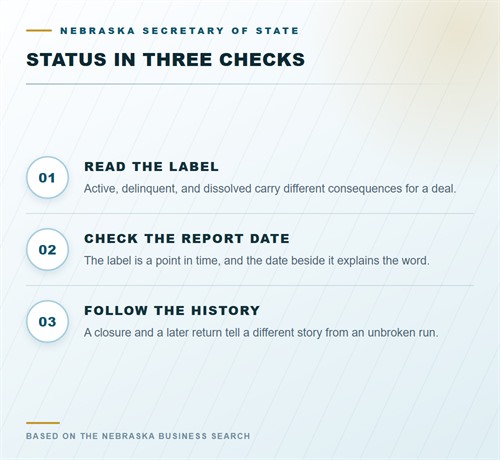
Nebraska publishes a short list of condition words, and each one carries a different consequence. The word appears on the result grid, on the file, and on a certificate with a seal, so a reader who quotes it should quote the date it was read. The word describes compliance rather than quality. Companies that share a label can be years apart in size and credit strength.
Active
A live company has reported for the cycle and keeps its registration standing. The word speaks to paperwork only, not to turnover or goodwill.
Delinquent
A delinquent flag appears when a report is late, and it can sit beside an otherwise open file. The flag is the office note that the compliance paper has not arrived. It is the value behind many refusals from a bank or a licensing board.
Dissolved or Revoked
An owners’ dissolution ends the registration by choice, while a revocation follows a failure to file and comes from the office. The labels differ, and so do the dates, and the word a reader quotes should match the entry.
What Changes a Standing
A condition moves when a paper arrives or when a deadline passes. The report is the usual trigger, and an amendment or a closure can move it as well. The deadline follows the class: an LLC or a nonprofit answers in odd years by April 1, while a corporation answers in even years by March 1 and turns delinquent after April 15.
The Report
The report restates the agent and the addresses, which is how the office keeps the file current. A company that moved without filing a change can miss the notice entirely.
Closure
A voluntary closure is a deliberate act, and the file shows the day the paper was accepted. The Nebraska corporation records page follows a charter through the same change. A reader who finds one should compare that day with the contract date, because an obligation may predate the end of the company.
Why Standing Matters in a Deal
A bank, a landlord, or a buyer reads the condition before anything else, because it decides whether the remaining papers are worth the effort. A contract with a closed company can be hard to enforce, and a payment to one can be hard to recover. The condition is a starting point rather than a conclusion. A live company can still be a poor risk, and a restored one can be stronger than a firm that never slipped.
Before a Contract
Check the condition on the day of signing rather than the day of negotiation. Save the printout with the agreement so a later reader can see what the register said at the time.
Before a Payment
A check before a first payment is the cheapest fraud control available. Confirm that the legal name on the invoice matches the record, that the condition is active, and that the address matches the agent.
Restoring Standing
A company that lost its registration can return through a reinstatement, and the path depends on how long it has been closed. The form names the company and the reports that were missed, and the office restores the file when the paper clears. Nebraska also publishes a late reinstatement for a longer lapse, and that route carries a much larger charge. A reader should confirm which form applies before sending a paper.
After the Return
Once the approval posts, the word turns active and the next report keeps the usual date. Order a certificate after the record updates, and send the copy to whoever raised the question.
Proving Standing to a Third Party
A screen answers a question for the reader, but a bank or a registry usually wants paper with a seal. The office issues a certificate for that purpose, and it states the condition on the day of issue. Most institutions set an age limit on the paper. A certificate from last quarter may be refused even when it is genuine, so order close to the date of use.
What the Certificate States
The certificate shows the name, the number, the type, and the condition on its issue day. It says nothing about owners, turnover, or permits, and it cannot promise that the registration will hold.
What It Does Not Prove
The certificate does not prove that a company pays its tax, holds a permit, or owns its equipment. Those facts sit with the Department of Revenue, the licensing board, and the county.
A Note for the File
A reader who checks a company should write three things: the entity number, the word that appeared, and the day of the lookup. The note answers a question months later without a second search, and a photograph of the screen is less useful because it carries no explanation.
Status Fees
The search is free, and the amounts below cover the papers that prove a condition or restore a file. Nebraska charges the same amount for a reinstatement whether the paper is filed in the office or online.
| Status item | In office | Online |
|---|---|---|
| Standing check | $0 | $0 |
| Certificate with a seal | $10 | $10 |
| Copies of records, per page | $1 | $1 |
| Standard reinstatement | $30 | $30 |
| Reinstatement after a long lapse | $500 | $500 |
| Amendment or correction to a report | $30 | $30 |
Frequently Asked Questions
Readers with a record open sent these questions about reading a condition.
Is a standing check free?
Yes. The search page shows the condition without a charge or a login. Charges begin with an ordered paper or a sent filing. A reader can check the same company again on the day of signing.
What does delinquent mean?
The report for the cycle has not arrived. Treat the file as unproven until a current receipt appears. A lender or a licensing board often pauses a matter at that word.
Can a dissolved company still trade?
It can keep operating in practice, but the state file no longer supports a claim of compliance. A reinstatement restores the registration and leaves the gap on the record. A contract signed in the gap can be hard to enforce.
Does an active label mean the business is safe to pay?
No. It means the reports are current. Credit, licensing, and tax standing sit outside the register. A live label beside an unpaid tax bill is a familiar pairing in a diligence file.
How long does a certificate last?
The paper states one day, and each recipient sets its own age limit. Ask the recipient what age it accepts, then order inside that window.