

Nebraska registered agent search finds the party that accepts legal papers for a business, and that party sits inside the entity record rather than in a separate index. A commercial service handles many companies, while a noncommercial agent is often an owner or an employee who agreed to the role. The field carries a name and a Nebraska street address.
This page covers the lookup, the two kinds of agent the state recognizes, the address rule that decides whether an appointment works, the change and resignation routes, service of process, and the limits of what the public file shows.
How to Find a Nebraska Registered Agent
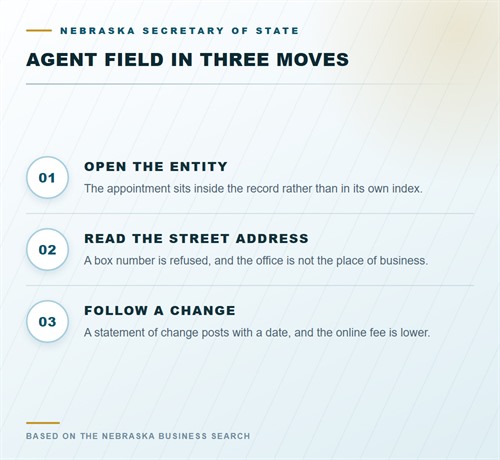
Open the entity record first, because the appointment belongs to the company rather than to the person. A reader can reach that record with a business name or an entity number, and the agent block sits below the name and the standing. No charge applies to the field, and no account is needed. The front page carries Nebraska registered agent search, which opens the same index.
By Business Name
Type the distinctive word and open the row whose type and city match the business. The agent block is one of several on the page, and it names a party plus a street address. A company that changed its agent during the cycle may still appear under the older name on a letter, while the state page shows the current appointment. A brand that returns no entity may belong to a trade name entry.
By Entity Number
The number reaches one file and skips the name question. The digits sit on the formation paper, on a notice about the report, and on an old receipt, and a rename never shifts them. A mistyped digit leaves an empty page rather than a close hit, and an empty page reads like a company that never filed. Check the paper first, then try the name.
Nebraska agent change fees:
https://sos.nebraska.gov/business-services
What the Agent Field Shows
The block carries the agent name and a street address inside Nebraska. It does not carry a telephone number, an email address, or a fee. The field is a service address rather than a general contact point. The Nebraska business records page covers the papers served there. A reader should copy both parts exactly. A name without the address is incomplete for a notice, and an address without the accepting party is incomplete for a court.
Name and Capacity
The name may be a person or a company, and the capacity matters. A commercial service is registered to do the work, while an individual accepts it as a duty. A reader who is checking a contract should confirm that the party named is the one that agreed.
Street Address Rule
The address must be a physical location in Nebraska where a paper can be handed over. A post office box is refused in this field, and a mailbox store can be refused when it does not accept service. A home address works when the owner accepts delivery there.
Commercial and Noncommercial Agents
Nebraska recognizes both kinds, and the difference is who accepts the role rather than what the role does. A commercial agent offers the service to the public and appears on many records. A noncommercial agent is connected to the company and takes the duty without selling it. An owner who picks a commercial service buys continuity, because the service stays in place when the owner moves. An owner who acts as the agent keeps the arrangement simple and accepts that a home address becomes public.
Commercial Agents
A commercial service keeps a staffed office and a process for accepting papers during business hours. The service usually reminds the client about the report, because a lost notice is the failure that ends most registrations.
Noncommercial Agents
A noncommercial agent must be a Nebraska resident or an entity with a street address in the state, depending on the class. The appointment is signed, and a filing without the signature is returned.
Changing or Resigning
A company can change its agent, its office, or both, and the statement of change carries a charge. The new party accepts the role, and the office posts the change with a date. A reader who sees a new agent mid-cycle should expect the next notice to reach the new party. A resignation follows a different route. The outgoing agent files a resignation, and the company then has a window to appoint a replacement before the file is affected.
Filing the Change
The form gives the company, the outgoing appointment, and the incoming one. An address change alone uses the same paper, and an agent change alone does too. The online figure sits below the counter figure.
Resignation
A resignation is filed by the agent rather than by the company, and Nebraska lists no fee for it. The paper names the company and the effective date. A company that receives a copy should appoint a replacement at once.
Service of Process
Service is the delivery of a legal paper to the party that agreed to accept it. The agent receives the paper, and the company is treated as having notice. A reader who is checking whether service was proper should confirm that the paper went to the address on the file on the date it was delivered. A notice sent to a former address is the failure that most often leaves a company unaware of a claim. The Nebraska business status page shows what a missed filing does to the record. The office does not forward a paper, and the agent does not chase a company that moved without filing a change.
After Service
A company that receives a paper should note the date and the party that signed for it. The note becomes part of the response file, and it is what a lawyer asks for first.
Agent Records and Privacy
The agent field is public, and the address on it is visible to anyone who opens the record. An owner who uses a home address should expect it to appear in a search engine as well as on the state page. A commercial service exists partly to keep that address off the file. The office does not publish an agent telephone number or email, and it does not list the agent other clients. A reader who needs the agent own standing can open the agent entity record when the agent is a company.
Checking a Commercial Agent
A commercial agent is a business, and its own file shows whether it is current. A service that has lost its registration is a risk to every company it represents, because a notice can go unanswered.
Choosing a Service
A reader who is comparing commercial agents should ask for the same information from each: office hours, a named contact, and a plan for a paper that arrives after the close of business. A service with a lapsed registration is a single point of failure for every client it holds.
Agent Fees
Reading the field is free. The appointment filings below carry the state amounts, and the online column is lower on the change form.
| Agent item | In office | Online |
|---|---|---|
| Agent search | $0 | $0 |
| Change of registered agent or office | $30 | $25 |
| Agent’s statement of change, per entity | $30 | $30 |
| Agent’s statement of resignation | No fee | No fee |
| Certificate with a seal | $10 | $10 |
Frequently Asked Questions
An owner choosing an agent, or a reader who received a paper, sent the questions below.
Is the agent search free?
Yes. The record opens without a profile, and the appointment is part of it. No charge is attached to reading the field. A reader can check the same company as often as the review requires.
Can the owner act as the agent?
Yes, when the owner meets the residency or address rule for the class. The appointment puts that address on the public file. An owner who wants the home address kept off the record should use a commercial service.
Does a change of agent cost anything?
Yes. The state charges for a statement of change, and the online figure sits below the counter figure. A resignation is listed with no fee, but a company that loses its agent can still miss a notice.
What happens if the agent resigns?
The company has a window to appoint a replacement. A file without an agent can miss a notice, so the replacement should be filed at once. The history shows the resignation and the new appointment.
Is the agent the owner of the business?
No. The role is about accepting papers, not about holding an interest. A commercial agent usually has no financial stake, and an owner who acts as agent holds the interest separately.