Nebraska business records search is the lookup a reader runs when a register summary is not enough and the paper trail has to be read. The corporate search page holds the formation papers, the amendments, the reports, and the closing papers for every entity, and it shows that index before a single copy is ordered.
This page covers the record list, the papers a buyer usually orders, the difference between a plain copy and a certified one, the certificate with a seal, the files of a closed company, the material the office never receives, and the charges attached to each request.
How to Search Nebraska Business Records
One field starts the lookup, and it takes either the legal name or the entity number. The number is the shorter route when a certificate is at hand, because it lands on the file with no list in between. A document request begins where any other lookup begins. A reader who wants the wider index can start at Nebraska business records search on the front page.
Finding the File
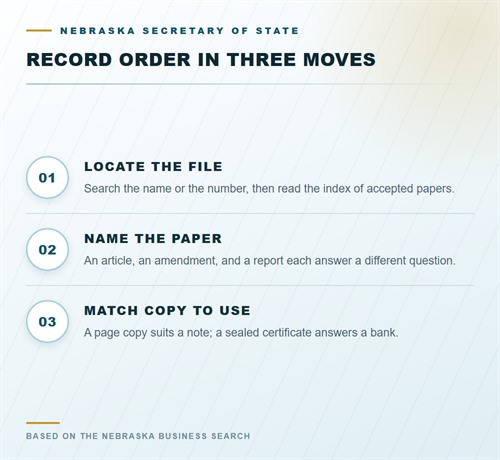
Type the distinctive part of the name and leave the designation off. A grid follows, with the type and the city beside each row. A company that renamed itself may appear under the current string. Where the name is uncertain, the number settles it. Those digits appear on a certificate, a report notice, and a receipt, and a rename never moves them.
Reading the Index
The record page carries an index of accepted papers, each with a type and a date. It is a catalogue rather than a library, so a reader can confirm that an amendment exists before deciding to buy it. A reader who orders without reading that catalogue can pay for a paper that does not hold the fact being sought. A name change sits in an amendment, and a closure sits in a dissolution. The Nebraska business status page reads the condition those papers produce.
Nebraska record fees:
https://sos.nebraska.gov/business-services
What the File Holds
A business file is a stack of papers rather than a narrative. It states what the company submitted, the day each paper was accepted, and the addresses the company declared. It does not carry revenue, customers, or reputation. The file answers a small set of questions well: whether the company is on the register, who accepts service, and what has been filed.
The Formation Paper
The certificate or articles that created the company carry the original name, the accepting party, the address, and the filing date. A reader who needs the exact wording of a clause buys a copy rather than trusting a summary.
Changes and Reports
An amendment records what changed and when the office took it in. A report confirms the agent and the addresses for a cycle. The two belong in one folder, because one answers what changed and the other answers whether the file stayed current.
The Closing Paper
A dissolution or a cancellation ends the registration, and the paper carries the day the office accepted it. A reader who needs to know when a company stopped filing should read that day rather than the last report date.
Copies and Certificates
Three products leave the same office, and each answers a different question. A plain copy gives the reader the text. A certified copy gives the text plus an attestation that it matches. A certificate with a seal gives neither text nor history, only a statement about the file on a day. A reader who buys the wrong product pays twice. A bank that wants a dated statement has no use for the articles.
Copies of Records
Nebraska charges by the page for a copy of a record. A reader who needs several papers should list each one on its own line, because the clerk prices the request by the pages produced. A plain copy serves a working note.
Certificates with a Seal
The certificate carries the office seal, and that seal is what a court or a bank accepts. The request names the entity and the document where one is involved. A certificate of good standing is the usual answer when a counterparty asks for proof of standing.
Records Held Elsewhere
The business file does not carry a tax account, a licence, a lien, or a lawsuit. Those records sit with the revenue office, the licensing board, the county, and the court. A clean business file and an unpaid tax bill can sit together without contradiction. The two facts do not contradict each other, because the offices keep separate indexes.
Tax and Licence Files
A sales or withholding account sits with the state revenue office, and a trade credential sits with the licensing body. A city or county permit sits with the local government. None of those appear on the business file.
Liens and Court Papers
A lien sits with the county or with the office that records it, and a lawsuit sits with the court. A reader who needs the litigation history asks the clerk for the case index rather than the business register.
Requesting a Document
An order moves through the office or the online service. The electronic route delivers a file and keeps a receipt, while a posted request brings paper after delivery time. A request that names the number and the exact paper moves without a follow-up question. The Nebraska registered agent page covers the address behind the file. A reader who needs a paper for a closing should order before the closing week. A routine request follows the office queue, and the fee schedule sets the charge.
What the Request Should Carry
The request carries the entity number, the paper type, and the filing date where it is known. A short cover note saves a round of questions, and a return address saves a second request.
Checking the Delivery
A receipt shows the day the order was placed, and it is the reference for a missing item. A reader who has not received a document after the stated window should quote the receipt.
Building a Folder
A working folder holds four items: the register printout with its date, the formation paper, the latest report, and a certificate with a seal dated for the transaction. An amendment joins the set when a name or an address moved during the review. Each item should carry the day it was ordered and the office that produced it. A reader who returns to the folder should see what was checked and when, without reopening the state site.
Record Fees
The lookup is free, and the amounts below cover the papers a reader can order. Nebraska prices a copy by the page and a certificate by the document, so the two rows differ in shape.
| Record item | Fee |
|---|---|
| Record lookup | $0 |
| Copies of records, per page | $1 |
| Certificate with a seal | $10 |
| Application for electronic access of records | $55 |
| Amendment or correction to a report | $30 |
Frequently Asked Questions
Buyers, owners, and researchers asked for a document rather than a summary, and their questions follow.
Are Nebraska business records public?
Yes. The file is open to anyone, and the lookup carries no charge. A charge applies to a copy or a certificate. A reader can open a record without stating a reason, which is what makes a check before a payment practical.
How is a copy priced?
By the page. A request for several documents costs more than a request for one, so list each paper separately. A short cover note with the entity number saves a round of questions.
Can I get a document from a closed company?
Yes. The file stays on the register after a closure, and the papers remain available. The list shows when the office closed it, and a certified copy can still be ordered.
Does the file include tax or licence records?
No. Those sit with the revenue office, the licensing board, and the local government. The business file covers filings and standing only, so an active company can still lack a permit.
What does a certificate cost?
Ten dollars for a certificate with a seal, which is the paper a bank usually asks for. A plain copy is priced by the page instead. A reader should order close to the date of use.